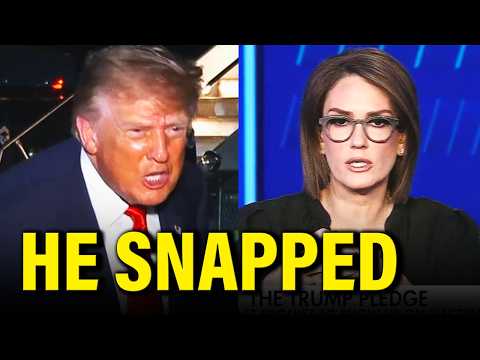
Donald Trump’s comments from Ireland give the commentary a substantial collection of material to work with: predictions about Iran, a proposed $5,000 payment to American adults, demands for lower interest rates, criticism of Ukrainian strikes on Russian fuel infrastructure, praise for China and another attack on wind power. The host’s central interpretation is that these remarks reveal an increasingly isolated and erratic administration whose threats have lost credibility abroad. Some of the underlying events are independently reported—the $5,000 proposal, for example, was publicly discussed and would require congressional involvement—but the presentation frequently moves from those events to much broader conclusions without establishing every step of the argument. Reuters +1
The economic section contains one of the more concrete conflicts. Trump argues that a $5,000 payment would be affordable because the government is bringing in enormous amounts of money, while the host emphasizes federal debt, inflation and the potential cost of such a program. That skepticism has a substantive basis: reporting places the potential cost above $1 trillion, and even Speaker Mike Johnson has said congressional approval would be required. AP News The commentary would nevertheless be stronger if it spent more time calculating or explaining the proposal rather than repeatedly describing it as fraudulent and attacking the people promoting it.
Interest rates provide another useful example of the presentation mixing a legitimate policy dispute with unnecessarily absolute attribution. The host argues that inflation has forced the Federal Reserve toward higher rates and places much of the responsibility on Trump’s economic policies. The Fed has in fact raised its target range by a quarter point to 3.75–4 percent and explicitly says inflation remains elevated, but its official statement also describes economic activity as expanding at a solid pace, domestic spending as resilient and capital investment as robust. Federal Reserve Those details complicate the host’s repeated depiction of an economy simply “reeling,” and incorporating them would have produced a more informative assessment.
Foreign policy dominates the remainder, with Iran, Russia, Ukraine, China, Canada and the Gulf states presented as pieces of the same argument: American coercive power is weakening while other countries develop alternatives. This gives the commentary a recognizable through-line rather than leaving it as a compilation of Trump clips. Yet claims about control of shipping routes, Saudi infrastructure, shifting Gulf alignments, China’s intentions and the consequences of American policy arrive rapidly and often with limited supporting context. Assertions that particular developments are entirely Trump’s fault, or that other leaders regard him in a particular way, are interpretations rather than demonstrated facts and should be treated accordingly.
The Ukraine segment is more effective when it stays close to Trump’s own position. His demand that Zelensky stop attacking Russian diesel infrastructure creates a clear policy question about balancing pressure on Russia against global energy costs. From there, however, the host shifts toward predicting a “massive” autumn and winter escalation and assigning responsibility for numerous geopolitical developments with considerable confidence. The argument would benefit from separating what has happened, what officials have said, what the host believes caused it and what he expects to happen next.
Presentation is the biggest weakness. Insults such as “lunatic,” “idiot,” “loser,” “scumbag” and “pathetic” appear so frequently that they compete with the substantive criticism, particularly when the host simultaneously promotes Ground News as a tool that helps keep his reporting objective. The sponsorship itself is relevant to the broader media-literacy discussion, but the contrast between advocating escape from partisan echo chambers and delivering intensely partisan commentary is difficult to overlook. The result can be energetic and engaging for an audience already sympathetic to the host’s perspective, but it gives skeptical viewers fewer reasons to trust the analysis.
There is still value in the sheer range of material assembled. Trump’s Ireland remarks are placed alongside Mike Johnson’s television interview, Federal Reserve policy, Ukraine, Iran, shipping disruptions and changing international relationships, creating a broad snapshot of several pressures confronting the administration. The problem is not a lack of specific subjects but insufficient discipline in evaluating them: factual reporting, inference, prediction, moral judgment and personal ridicule repeatedly blur together. A tighter presentation that retained the documented contradictions while dropping the mind-reading and insults would make the underlying critique considerably more persuasive.
Pros
- Uses Trump's own extended remarks to establish several genuine policy questions involving Iran, fuel prices, Ukraine, interest rates and the proposed $5,000 payments.
- Connects domestic economic arguments with foreign-policy developments rather than treating each Trump statement as an isolated controversy.
- Raises a substantive affordability and congressional-authorization issue surrounding the proposed payments that has also surfaced in broader reporting.
- Encourages viewers to compare how different ideological segments of the media frame the same developments.
Cons
- Frequent personal insults and declarations about Trump’s mental state substitute rhetoric for analysis and undermine the stated commitment to objective reporting.
- Numerous geopolitical claims and causal conclusions are delivered with more certainty than the supporting material shown warrants.
- The economic discussion selectively emphasizes negative indicators while giving little attention to evidence that complicates its characterization of the broader economy.
- Predictions about escalation, international realignment and other countries’ motives are not consistently distinguished from established developments.
A large collection of consequential Trump remarks gives the commentary plenty of substantive material, and its best sections identify real questions about fiscal policy, inflation and American foreign-policy leverage. Its analytical value is weakened by relentless partisan rhetoric and by treating several interpretations and forecasts as though they were settled conclusions, leaving a presentation that is more effective as forceful political commentary than as the objective reporting it sometimes claims to provide.