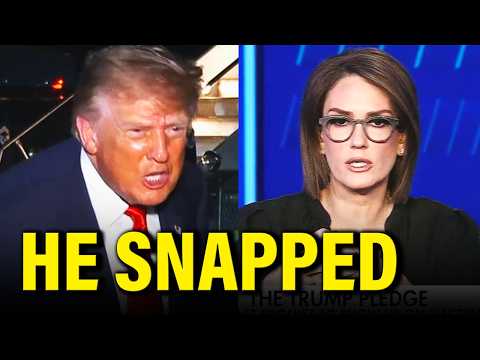
Donald Trump's reaction to a major Republican election defeat provides the foundation for a fiercely critical examination of his political standing, immigration policies, and remaining influence over the Republican Party. The commentary focuses on previews of Trump's upcoming 60 Minutes interview, conducted by Ross Douthat, who reportedly described the president as visibly defeated and unusually reflective. The host interprets these observations as possible evidence that Trump recognizes the deterioration of his political position. However, the suggestion that his presidency has effectively ended goes considerably further than the limited interview excerpts can establish.
The opening effectively creates anticipation around Trump's apparent change in demeanor, particularly his willingness to acknowledge political difficulties following the election. His public statement expressing hope that 60 Minutes will highlight his administration's accomplishments provides an interesting contrast with the interviewer's reported impressions. The host also considers what Trump might attempt during the remaining Republican-controlled congressional session, including possible changes to Senate procedures and judicial confirmations. These possibilities introduce relevant political considerations, although the discussion quickly moves from interpreting Trump's statements to predicting investigations, presidential pardons, and efforts to protect his personal interests without establishing sufficient evidence for those specific intentions.
Immigration enforcement becomes the commentary's most substantial policy discussion. Trump's reported acknowledgment that his administration's approach went too far is contrasted with the uncompromising positions attributed to conservative commentator Tomi Lahren and Trump adviser Steve Cortes. Their objections to reduced deportations illustrate a genuine ideological tension within the political coalition described by the host. The presentation also raises serious allegations involving civil liberties violations, unlawful deportations, and deaths connected to federal enforcement actions. These accusations deserve scrutiny, but the commentary provides insufficient supporting documentation or legal context to establish the circumstances and responsibility surrounding individual cases.
The examination of Lahren's statements gives the discussion a useful opposing perspective, even if the host's treatment of her arguments is consistently hostile. Her insistence that deportation policies should have been more aggressive contrasts sharply with Trump's apparent willingness to reconsider their severity. The host argues that excessive enforcement, masked federal agents, and concerns about civil rights alienated voters rather than a lack of sufficiently aggressive deportations. This is a plausible political interpretation, but the presentation does not provide polling results or detailed electoral evidence to demonstrate how widespread these attitudes were among different voter groups. The argument would be stronger if it distinguished more carefully between the commentator's conclusions and measurable public opinion.
Stephen Miller's reported appointment as White House chief of staff becomes another important element of the analysis. The host identifies an apparent contradiction between Trump's suggestion that immigration enforcement became too harsh and his decision to elevate an official portrayed as a principal architect of those policies. This comparison raises a legitimate question about whether Trump's public reflections will produce meaningful changes in administration priorities. Nevertheless, the host's repeated use of highly charged descriptions of Miller and other political opponents weakens the impression of detached analysis. The emotional language reinforces the commentary's partisan identity but often replaces a more detailed examination of institutional authority, policy implementation, and competing political incentives.
The later interview excerpts concerning Republican election losses provide some of the presentation's most useful material. Trump reportedly attributes the defeat to ineffective messaging and insufficient voter turnout, while the host argues that the administration's policies and performance made successful messaging increasingly difficult. Particularly noteworthy is the acknowledgment that preliminary election data suggested Republican turnout problems played a larger role than widespread partisan defections, although some Republican voters reportedly supported Democrats. This distinction adds welcome nuance to an otherwise sweeping interpretation of the election. Still, the analysis offers no specific turnout figures, state-level comparisons, or verified breakdowns to substantiate its conclusions about the causes of Republican losses.
Ultimately, the commentary combines engaging political interpretation with an unmistakable desire to see Trump's influence collapse. Its conversational delivery, direct responses to interview excerpts, and examination of disagreements among conservative figures create a lively and accessible presentation. However, the repeated declarations that Trump is politically finished are difficult to reconcile with the host's own warnings that he retains substantial executive authority and may pursue an aggressive political strategy during his remaining time in office. The analysis also relies on previews of an interview that had not yet aired in full, making its sweeping conclusions particularly premature. The result is an energetic piece of partisan commentary that raises worthwhile questions but frequently treats speculation and political judgment with greater certainty than the available material supports.
Pros
- The opening establishes a timely political conflict through Trump's reported reaction to Republican election losses and his upcoming 60 Minutes appearance.
- Ross Douthat's observations about Trump's demeanor provide an interesting starting point for examining the president's apparent recognition of political setbacks.
- The contrast between Trump's immigration comments and the positions of Tomi Lahren and Steve Cortes illustrates significant disagreements within the conservative movement.
- The discussion of Stephen Miller's reported promotion raises a relevant question about the relationship between presidential rhetoric and actual administration policy.
- The examination of Trump's complaints about campaign messaging effectively connects his public leadership role with Republican electoral performance.
- The acknowledgment that low Republican turnout may have mattered more than widespread voter defections introduces useful nuance into the election analysis.
- The direct excerpts and conversational delivery make the political arguments accessible and maintain a strong sense of urgency.
Cons
- The declaration that Trump's presidency has effectively ended is an exaggerated conclusion unsupported by the limited interview material presented.
- Serious allegations involving immigration enforcement, unlawful deportations, and fatalities lack sufficient supporting evidence and legal context.
- Assertions about widespread public opposition to immigration enforcement and the causes of Republican electoral losses are not supported by detailed polling or election statistics.
- The frequent profanity, personal insults, and inflammatory descriptions of political opponents undermine the commentary's analytical credibility.
- Predictions about future investigations, presidential pardons, corruption, and Trump's personal motivations rely heavily on speculation.
- The reliance on selected interview previews rather than the complete conversation limits the reliability of conclusions about Trump's political outlook and intentions.
Trump's apparent post-election frustration and divisions within the conservative movement provide substantial material for an engaging examination of Republican political difficulties. The commentary succeeds in highlighting contradictions surrounding immigration policy, electoral messaging, and presidential leadership, but its forceful partisan framing frequently overwhelms the supporting evidence. Viewers seeking an energetic political perspective will find plenty to consider, while those looking for a measured, thoroughly substantiated assessment of Trump's remaining presidency will find the analysis considerably less convincing.