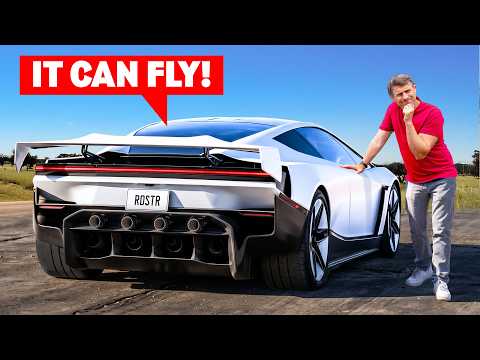
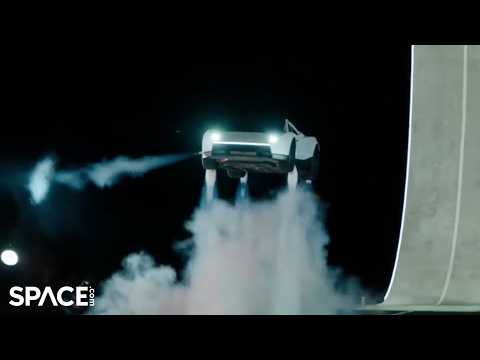
Tesla’s redesigned Roadster performs a dramatic aerial maneuver using cold gas thrusters, creating one of the most extraordinary automotive demonstrations the Waveform team has witnessed. Yet behind the spectacle lies a familiar problem: Tesla is once again promoting a vehicle with extraordinary capabilities, limited production details, and an uncertain delivery timeline. Marques Brownlee, Andrew, David, and the rest of the team examine whether the engineering achievement represents a meaningful breakthrough or another elaborate demonstration designed primarily to generate publicity.
The discussion benefits considerably from Marques' detailed explanation of the proposed Roadster lineup. He outlines four versions, ranging from a conventional electric sports car to an extreme configuration incorporating suction fans and multiple cold gas thrusters. The technical breakdown covers compressed nitrogen storage, propulsion bursts, aerodynamic grip, and the differences between the demonstrated capabilities and realistic road use. Importantly, the hosts distinguish information attributed to Tesla engineers and automotive journalists from specifications that remain unconfirmed. Their skepticism becomes particularly relevant when examining Elon Musk's suggestion that the vehicle could eventually reach half the speed of sound, a claim the team considers unrealistic given current automotive limitations.
Safety and practicality receive equally serious consideration. The hosts explain why suction-based aerodynamic systems require carefully maintained surfaces and why powerful thrusters introduce substantial risks involving noise, vehicle control, and potential misuse. They also question whether the Roadster's aerial maneuvers could safely accommodate passengers or would instead function as autonomous demonstrations on specially designated tracks. Comparisons with the McMurtry Spéirling help establish that extreme suction-based performance is not entirely unprecedented, while identifying what makes Tesla's additional propulsion systems unusual. These observations provide useful engineering context without confusing an impressive demonstration with a proven consumer product.
The most persuasive criticism concerns Tesla's history of delayed promises. The team recalls the original Roadster announcement, the substantial deposits collected from prospective customers, and the transformation of that earlier concept into an entirely different vehicle. Questions about reservation transfers, trim eligibility, pricing, production order, and refunds remain unresolved in the discussion. Particularly concerning is the reservation agreement language acknowledging that delivery cannot be guaranteed. Marques' perspective carries additional weight because he previously committed money toward the Roadster, giving his skepticism a concrete foundation rather than making it appear to be opposition for its own sake.
The hosts also explore the Roadster as a marketing instrument rather than a conventional product launch. They argue that Tesla's objective may be to strengthen its reputation as a technologically ambitious manufacturer, regardless of whether the extreme versions achieve meaningful production volumes. This interpretation becomes more convincing when they examine the event's emphasis on spectacular stunts instead of measurable specifications, practical features, or firm delivery commitments. However, claims about Tesla's internal marketing intentions and the likelihood of future production remain interpretations rather than established facts. The discussion occasionally becomes overly dismissive, particularly when criticizing Musk's presentation style and speculating about the company's priorities.
Porsche's Mission S concept provides an effective counterpoint. Introduced at an event held on the same day, Porsche's proposed high-end sports car attracts attention through its styling, mid-engine layout, physical instrumentation, and traditional driver-focused details rather than spectacular performance demonstrations. The team notes that Porsche also withheld major specifications, but identifies important differences: Porsche was not immediately collecting reservations, and its established production reputation encourages greater confidence. Their comparison raises an interesting question about how manufacturers earn consumer trust. Nevertheless, the discussion sometimes treats Porsche's future delivery as more certain than the available information establishes, relying heavily on the company's historical reputation.
As a complete Waveform episode, the presentation offers considerably more than automotive commentary. An extensive opening discussion examines Apple's folding iPhone Duo, including poorly optimized applications, awkward ergonomics, disappointing cameras, strong battery performance, and the compromises of early-generation hardware. The hosts also speculate about upcoming MacBook Pro upgrades before moving through sponsorships, technology news, and their recurring trivia competition. These segments contain worthwhile observations, especially the hands-on descriptions of the folding phone, but they substantially delay the Roadster discussion and make the episode less focused than its title suggests. The conversational humor and occasional disagreements maintain an enjoyable atmosphere, although lengthy tangents and repeated jokes sometimes interfere with the sharper technical analysis.
Pros
- Provides a detailed explanation of the proposed Roadster variants, including suction fans, compressed nitrogen thrusters, performance claims, and their possible engineering limitations.
- Separates the extraordinary live demonstrations from the unresolved questions surrounding production, pricing, safety, and practical usability.
- Examines Tesla's history of Roadster delays and substantial customer deposits, giving the discussion an important consumer-protection perspective.
- Uses the McMurtry Spéirling and other performance vehicles to contextualize Tesla's technology rather than presenting every demonstrated capability as unprecedented.
- Offers a thoughtful comparison between Tesla's spectacle-driven announcement and Porsche's more restrained Mission S presentation.
- Balances genuine enthusiasm for the engineering demonstrations with skepticism about exaggerated promises and uncertain delivery schedules.
Cons
- The lengthy discussion of the iPhone Duo and upcoming Apple products delays the principal automotive segment and weakens the episode's overall focus.
- Some conclusions about Tesla's marketing objectives, future production priorities, and Musk's motivations rely on speculation rather than independently established evidence.
- The criticism of Tesla's presentation occasionally becomes repetitive, emphasizing its lack of concrete information without consistently adding new insight.
- Porsche receives greater benefit of the doubt based on its reputation, despite similarly incomplete specifications and uncertain production details.
- Sponsorship interruptions, extended jokes, and trivia segments contribute to an unnecessarily long runtime for viewers primarily interested in the Roadster.
Waveform delivers an entertaining and informative examination of Tesla's ambitious Roadster revival, successfully separating remarkable engineering demonstrations from the difficult realities of delivering an expensive, technologically complicated vehicle. The discussion is particularly effective when evaluating technical limitations, consumer expectations, and the contrast between Tesla's and Porsche's approaches to revealing future cars. Although the broader episode suffers from excessive detours and occasionally speculative criticism, its central automotive analysis offers a valuable reminder that a spectacular demonstration is not the same as a finished product.