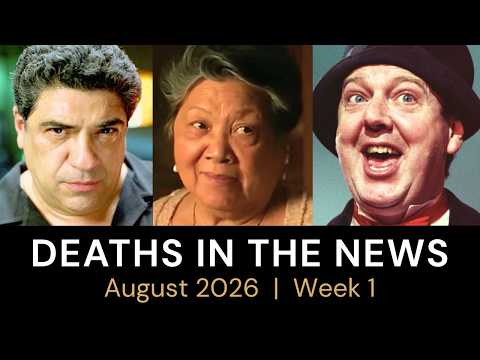
Peter Cullen receives one of the more vivid profiles here, with the discussion connecting his Optimus Prime performance to the advice he reportedly received from his older brother and then tracing his work through Transformers, Winnie the Pooh, Predator, Voltron and G.I. Joe. That biographical approach gives the tribute format some substance beyond simply listing names and ages. Similar care appears in several later entries, where familiar screen roles are paired with teaching careers, charitable work, family life or other details that help present the subjects as more than recognizable faces.
The central structural problem is that the presentation promises a tightly defined collection but delivers something much broader. Despite the title specifying 15 famous actors who died “in the last few days,” the piece runs through considerably more than 15 people and includes musicians, a model, a director-screenwriter and reality television personalities alongside actors. Nothing within the presentation explains why these particular deaths belong together chronologically, so the urgency implied by “last few days” is never meaningfully established.
Several profiles are nonetheless effective miniature career summaries. Piper Laurie is contextualized through The Hustler, Carrie, Children of a Lesser God and Twin Peaks, while Richard Moll's Night Court work is balanced with his extensive voice acting. Mark Goddard's transition from Lost in Space performer to special education teacher and Joan Evans' decision to leave acting young and later work in education are especially worthwhile additions because they give viewers a broader sense of each person's life after their best-known screen roles.
The tone is generally respectful, particularly when discussing younger deaths and serious illnesses. Willie Spence's fatal crash, Lucy Markovich's medical struggles and the cancer-related deaths are handled without sensational description. The entries concerning Jeff Baena and Nicky Katt also state suicide directly without turning those deaths into dramatic narrative devices, although such sensitive material would benefit from particularly careful sourcing and polished presentation.
Accuracy and editing are much shakier. Numerous names, titles and character references are garbled or misstated in the narration, including obvious problems involving Wednesday Addams, The Addams Family, Two-Face, The Principal and other recognizable works. There are also pronoun errors and awkward phrases such as references to “Wi-Fi television viewers.” Those mistakes are especially damaging in a memorial compilation because identifying a person's work correctly is fundamental to treating the subject with care.
The collection also regularly presents precise causes of death, locations, medical histories and final-life circumstances as settled information without showing where those claims come from. Statements about stroke causes, accidental drug toxicity, pulmonary fibrosis, cancer diagnoses, brain tumors and other medical details may be accurate, but within this presentation they are simply asserted. The same applies to sentimental details about final months, family surroundings and how friends or colleagues supposedly remembered the deceased. A tribute format does not require exhaustive documentation, but such specificity demands stronger visible grounding than viewers receive here.
Taken individually, many of the biographies contain interesting material, and the breadth of careers represented gives older television, film, theater and music fans plenty of recognizable names. As a finished package, however, the piece feels insufficiently edited. Its mismatch between headline and contents, repeated wording errors and unexplained chronology keep a potentially respectful memorial collection from feeling dependable.
Pros
- Several entries provide meaningful career context rather than limiting each person to a single famous role.
- Details about later careers in teaching, counseling, writing and community work add human dimension to the memorials.
- The overall tone remains restrained and respectful when covering illness, accidents and suicide.
- Profiles of performers such as Piper Laurie, Richard Moll and Mark Goddard effectively convey the range of their professional lives.
Cons
- The promised count and subject matter do not match the actual contents, which extend well beyond 15 people and include several figures who were not primarily actors.
- The “last few days” framing is never supported with dates or an explained time window.
- Frequent garbled names, character references, titles, pronouns and phrases seriously weaken editorial credibility.
- Detailed medical causes, final circumstances and personal recollections are presented without visible sourcing or qualification.
- The repetitive obituary format offers little connective structure explaining why these particular people were grouped together.
There is genuine value in the effort to remember performers whose careers stretched across classic Hollywood, television, theater, voice acting and independent film. Unfortunately, the tribute's usefulness is substantially reduced by a misleadingly narrow headline, conspicuous editing errors and highly specific biographical claims presented without clear support. More careful verification and tighter editorial control would have made the memorial considerably more authoritative and respectful.