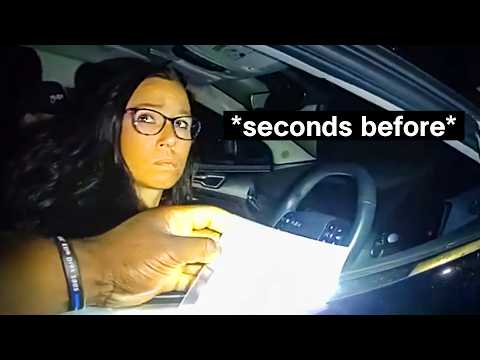
Flashing red and blue emergency lights at passing motorists might seem like an effective way to discourage speeding, but one driver's attempt to regulate traffic attracts the attention of actual law enforcement officers. What begins as an unusual roadside encounter develops into an investigation involving suspected police impersonation, questionable employment history, and the improper use of emergency equipment. The combination of police footage and experienced law enforcement commentary creates an engaging examination of the incident and the legal considerations surrounding it.
The driver's repeated insistence that he was merely attempting to slow down speeding motorists provides an interesting foundation for the investigation. He appears remarkably forthcoming about using the emergency lights, seemingly unaware of the potential seriousness of his actions. His encounters with off-duty police officers make the circumstances particularly unusual, while their account of his driving behavior gives the investigating officers additional information beyond his own explanation.
One of the more interesting developments involves the driver's inconsistent descriptions of his previous involvement with the Los Angeles Police Department. The commentator examines his references to the former CRASH unit and explains why certain aspects of his language raise suspicions. Although this background provides useful insight into how experienced officers assess questionable claims, the suggestion that resigning from a police department frequently indicates impending termination is insufficiently supported. Suspicious terminology and inconsistent statements warrant further investigation but do not independently establish someone's employment history.
The coverage becomes particularly informative when the responding officers discuss whether the driver's conduct satisfies the legal requirements for police impersonation or merely constitutes improper use of emergency lights. Rather than immediately agreeing on a charge, they consider the significance of his actions, statements, and the applicable statutes. Their uncertainty provides a valuable illustration of the difference between recognizing potentially unlawful behavior and establishing the necessary elements of a specific criminal offense.
Additional commentary concerning Miranda rights and warrantless vehicle searches adds educational value to the presentation. The explanation of custodial interrogation is especially worthwhile because it encourages viewers to consider whether the circumstances of questioning require constitutional warnings. However, the discussions surrounding vehicle searches and potential forfeiture would benefit from greater attention to their legal limitations. The officers' enthusiasm about potentially repurposing the suspect's vehicle also deserves more critical examination rather than being treated primarily as an operational benefit.
The roadside footage generally demonstrates a relatively controlled encounter, with officers questioning the driver, explaining their concerns, and eventually informing him of his arrest. Nevertheless, some of their profanity, jokes, and dismissive remarks contrast with the commentator's broadly favorable assessment of their professionalism. The extended informal conversations during the vehicle search also weaken the pacing, while the driver's repeated explanations become increasingly redundant without providing substantial new information.
According to the account cited near the conclusion, the driver was charged with impersonating a police officer, improper use of emergency lights, and a license plate cover violation. Unfortunately, the coverage does not establish the eventual outcome of those charges or independently resolve his claimed law enforcement background. The commentator's broader discussion of why individuals might impersonate officers raises interesting psychological questions, but the man's underlying motivation remains uncertain beyond his stated desire to control speeding motorists. The closing segment featuring a donated military coin and research concerning unidentified anomalous phenomena is personable but unrelated to the central investigation.
Pros
- The unusual roadside encounter establishes an immediately engaging premise grounded in an actual police investigation.
- The combination of police footage and law enforcement commentary provides useful insight into investigative procedures.
- The driver's inconsistent explanations create an interesting examination of credibility and claimed police experience.
- The officers' discussion of applicable criminal charges illustrates the importance of establishing the necessary elements of an offense.
- The explanation of Miranda rights provides an accessible introduction to the distinction between investigative detention and custodial interrogation.
- The presentation highlights the potential dangers of civilians attempting to exercise unauthorized law enforcement authority.
Cons
- The commentator makes insufficiently supported generalizations about police resignations and the motivations behind police impersonation.
- The legal discussion of vehicle searches and forfeiture lacks adequate context regarding their limitations and procedural safeguards.
- The favorable assessment of police professionalism overlooks some questionable remarks and premature enthusiasm about acquiring the suspect's vehicle.
- Repetitive questioning and extended informal conversations occasionally undermine the pacing.
- The absence of a confirmed judicial outcome leaves important aspects of the case unresolved.
- The closing discussion of military memorabilia and unidentified anomalous phenomena distracts from the central subject.
An unusual traffic encounter develops into an informative exploration of police impersonation, investigative discretion, and the boundaries of civilian authority. The law enforcement commentary provides meaningful educational context, although greater legal precision, more balanced scrutiny of the officers' conduct, and additional information concerning the case's eventual resolution would have strengthened the presentation. Despite these shortcomings, the coverage offers an engaging and worthwhile experience for viewers interested in police investigations and criminal justice.