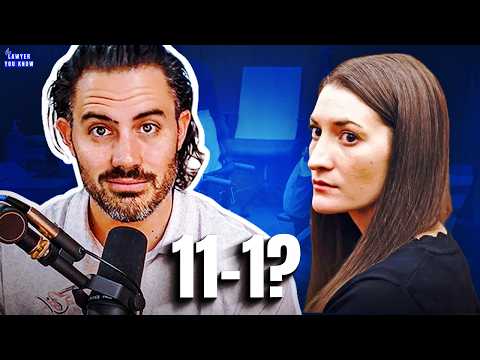
Lindsay Clancy’s acknowledged role in the deaths of her three children sits at the center of the case presented here, yet much of the discussion is aimed at correcting online theories that treat the trial as though her lawyers are arguing she never committed the killings. The host repeatedly emphasizes that the defense instead rests on criminal responsibility: whether Clancy was legally insane at the time. That distinction is one of the program’s most useful contributions because it gives viewers a clearer framework for understanding why evidence about her mental state matters even when the underlying acts themselves are not being denied by the defense.
The strongest sections dismantle specific social-media claims by comparing them with information described as coming from testimony, surveillance footage and legal filings. The discussion of Clancy’s husband is especially direct, pointing to CCTV placing him away from the home and to Clancy’s own statements, defense strategy and civil allegations as reasons the theory that he secretly committed the killings requires increasingly elaborate assumptions. The host is effective at showing how conspiracy reasoning can survive contradictory evidence simply by inventing another hypothetical explanation each time a claim is challenged.
Other evidentiary points are similarly accessible. The explanation that fingerprints are not automatically recoverable from every surface and that family exercise bands could reasonably contain mixed DNA is a useful corrective to television-inspired expectations about forensic evidence. The discussion of Clancy’s severe hypothermia after her injuries also presents the medical testimony as described in court, including blood loss, exposure and paralysis as possible contributors rather than treating the temperature reading as proof of a hidden scenario.
The treatment of psychiatric medication and psychosis is more problematic. The host cites toxicology levels and distinguishes therapeutic, elevated and subtherapeutic concentrations, which helps push back against the simplistic idea that merely taking several psychiatric medications proves incapacity. However, the program then moves into broad declarations about what particular drugs, mania and psychosis can or cannot cause. Some of those statements are presented with greater certainty than the material provided can independently establish, especially when discussing how long psychosis should last, how hallucinated commands operate and whether a brief psychotic episode is plausible.
That issue becomes particularly important because the insanity defense is the central legal dispute. The host argues that Clancy’s reported account of hearing a male voice only during the killings is inconsistent with how psychosis normally functions and says this interpretation is supported by psychiatric professionals. Yet the presentation does not fully explore competing expert testimony, diagnostic uncertainty or the exact legal standard the jury must apply. As a result, viewers receive a forceful argument against the defense rather than a comprehensive examination of the competing psychiatric evidence.
The discussion of whether the medical system failed Clancy raises worthwhile questions but also simplifies a difficult issue. The host stresses that she reportedly did not disclose suicidal or homicidal thoughts to the doctors treating her, even during inpatient care, and reasonably notes that clinicians cannot directly respond to symptoms they have not been told about. At the same time, the argument places substantial weight on patient disclosure without examining whether clinicians had other warning signs, what family members communicated, or what responsibilities might still have existed within her treatment. That makes the dismissal of her civil claims feel premature based on the evidence presented here.
Presentation is both the program’s greatest strength and its most obvious limitation. The host is energetic, blunt and often funny, using exaggerated examples to expose how speculative online theories can become detached from evidence. But insults aimed at TikTok commentators, mothers, astrologers and jurors repeatedly push the tone from criticism into ridicule, while the suggestion that the gender makeup of the jury explains the deadlock is unsupported. The result is entertaining advocacy with several valuable evidentiary points, but not the detached trial analysis its subject deserves.
Pros
- Clearly explains the crucial difference between disputing the killings and asserting an insanity defense against criminal responsibility.
- Uses specific examples involving surveillance footage, legal statements, DNA, fingerprints and medical testimony to challenge speculative internet theories.
- Effectively illustrates how conspiracy arguments can become unfalsifiable by continually inventing new explanations for contradictory evidence.
- Makes several complicated legal and forensic issues understandable to a general audience.
Cons
- Psychiatric claims about psychosis, medication effects and hallucinated commands are sometimes stated more definitively than the evidence presented can support.
- The insanity defense is criticized forcefully without a comparably detailed presentation of the strongest expert evidence supporting it.
- The discussion of possible medical negligence simplifies the responsibilities of clinicians and dismisses the civil case before fully examining its underlying arguments.
- Mockery and personal insults frequently overwhelm the otherwise useful evidentiary analysis.
- Speculation about the jury’s gender composition and the reasons for its deadlock is unsupported.
The program is most persuasive when it separates documented evidence from the increasingly elaborate theories circulating around the case and explains what the insanity defense is actually asking the jury to decide. Its credibility weakens when psychiatric complexity and jury deliberations are reduced to confident assertions or ridicule, leaving a sharp and often informative rebuttal to online misinformation that works better as advocacy than as a fully balanced legal analysis.