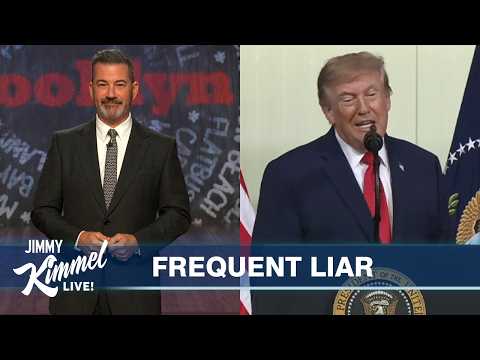
Jimmy Kimmel wastes little time turning a difficult election night for Republicans into a celebration of Democratic gains, combining developing midterm results with relentless jokes about Donald Trump and his political allies. With Democrats projected to take control of the House and several prominent races appearing to favor their candidates, Kimmel delivers a politically charged monologue built around Republican setbacks, presidential frustration, and the possibility of a dramatically different Congress. His enthusiasm is unmistakable, although the presentation is designed primarily for viewers who share his political perspective rather than those seeking an impartial examination of the election.
The opening establishes an entertaining rhythm through Guillermo's assignment as the show's election correspondent, a deliberately unproductive role that provides recurring interruptions throughout the monologue. Kimmel mixes references to election forecasts with jokes about Trump's campaign appearances, Donald Trump Jr.'s public speaking, and the president's late-night social media activity. His discussion of an Alaska Senate race involving candidates with similar names provides an especially effective opportunity to ridicule Trump's spelling and accusations of electoral misconduct. The humor benefits from Kimmel's quick delivery and the contrast between serious political developments and increasingly ridiculous observations, although some of the more personal insults feel less inventive than the material built around actual statements.
The election analysis becomes more substantial when Kimmel discusses Democratic victories and the broader political consequences of Republican losses. He highlights John Ossoff's reported Senate victory in Georgia, Keisha Lance Bottoms' historic gubernatorial achievement as described during the broadcast, and James Talarico's apparent lead in Texas. These developments are presented as signs of a significant Democratic resurgence, but the coverage remains preliminary, with several races still unresolved. Kimmel also contrasts concerns he attributes to ordinary Americans, including inflation, housing, health care, corruption, and democracy, with issues he associates with Trump's political movement. The comparison communicates his criticism of Republican priorities effectively, but its selective framing offers little consideration of competing voter concerns or the complexity behind individual election outcomes.
Election integrity receives considerable attention as Kimmel criticizes the administration's reported deployment of federal election monitors and raises concerns about voter intimidation in predominantly Democratic areas. He also references allegations involving discriminatory electoral boundaries and mocks Homeland Security Secretary Markwayne Mullin's awkward explanation of post-election voter verification procedures. The accompanying footage gives the segment a stronger foundation than jokes based entirely on speculation, particularly when Mullin struggles to articulate his position. However, Kimmel treats several serious allegations about election administration and government interference as established political realities without providing enough supporting detail to evaluate their accuracy independently. The distinction between documented events, accusations, and comedic exaggeration is not always sufficiently clear.
Some of the evening's funniest moments emerge from political figures creating uncomfortable situations without much assistance from Kimmel. A particularly effective segment features California gubernatorial candidate Xavier Becerra repeatedly avoiding an endorsement of Los Angeles Mayor Karen Bass while standing beside her. The awkward exchange becomes increasingly amusing as the interviewer presses for a straightforward answer and Becerra continues emphasizing their friendship instead. Kimmel also explores Idaho's unusual state-gun ballot question, transforming the competing firearm options into a mock campaign advertisement featuring exaggerated attacks on a Colt pistol and an endorsement of the Winchester 1894. These segments demonstrate the show's ability to turn unusual political circumstances into accessible comedy, with the fabricated gun advertisement providing a welcome departure from the repeated Trump-focused material.
The anticipated transfer of House leadership provides another major comedic opportunity, particularly through Kimmel's discussion of Hakeem Jeffries potentially replacing Mike Johnson as speaker. His jokes about Trump's reaction to Jeffries are followed by a compilation of Johnson's public statements, including expressions of loyalty toward the president, uncomfortable exchanges with reporters, and repeated claims of insufficient knowledge about controversial matters. The montage is one of the more effective pieces of political satire because the humor develops through the accumulation of Johnson's own remarks rather than relying exclusively on Kimmel's commentary. Nevertheless, the selection is plainly designed to reinforce an unfavorable characterization, and viewers receive little broader context for the individual clips.
The final stretch shifts away from electoral commentary when Kimmel's assistant Natalie arrives with an increasingly bizarre collection of personal services and supposed updates. Her exaggerated descriptions of her responsibilities, an old Costco magazine featuring Kimmel, and an attempt to wrap him in protective material create a deliberately chaotic interruption. The escalating absurdity offers a change of pace after the politically dense monologue, and Kimmel's reactions help sell the awkward humor. However, the sketch becomes increasingly disconnected from the election coverage, particularly as Natalie climbs into her bag and continues the routine. While the exchange provides a memorable comedic finish, it also weakens the sense of closure surrounding the night's political developments.
Pros
- Kimmel's energetic delivery and rapid-fire political humor make developing election results entertaining without allowing the monologue to become overly procedural.
- The discussion of Democratic gains, potential House leadership changes, and Republican setbacks provides a recognizable political framework for the comedy.
- Actual footage of Donald Trump Jr., Markwayne Mullin, Xavier Becerra, and Mike Johnson creates several effective moments of humor rooted in public statements and uncomfortable exchanges.
- The Idaho state-gun campaign parody introduces an imaginative comedic premise that stands apart from the more predictable presidential insults.
- The Mike Johnson compilation uses contrasting statements and awkward public appearances to construct a particularly effective satirical sequence.
- Guillermo's recurring interruptions and Natalie's increasingly absurd appearance add variety to the presentation and showcase the show's supporting personalities.
Cons
- The overwhelmingly Democratic perspective leaves little room for alternative interpretations of the election results or a balanced examination of Republican arguments.
- Serious claims involving election monitoring, voter intimidation, and discriminatory electoral practices receive limited supporting evidence or contextual explanation.
- Several election outcomes are discussed while results are still developing, reducing the segment's usefulness as a definitive account of the midterms.
- Repeated jokes about Trump's appearance, personal relationships, and intelligence occasionally substitute familiar insults for more substantial political satire.
- Natalie's extended closing sketch drifts considerably from the election coverage and prevents the monologue from ending with a stronger political conclusion.
Jimmy Kimmel delivers an energetic and frequently amusing election-night monologue that combines Democratic celebrations, embarrassing political footage, and inventive comedy sketches. The strongest material comes from uncomfortable real-world exchanges and carefully assembled clips, while the partisan framing, limited examination of serious allegations, and occasionally repetitive insults reduce its analytical value. As political entertainment, the segment succeeds more consistently than it does as a comprehensive account of the election, offering plenty of laughs for receptive viewers without providing much perspective beyond Kimmel's established position.