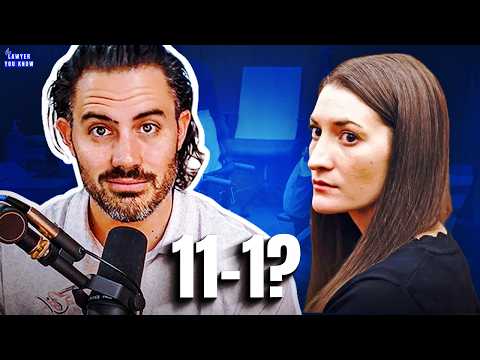
Lindsay Clancy's physical injuries, mental-health history and the disputed timeline surrounding the deaths of her three children form the core of a discussion focused less on proving an alternative theory than on identifying possible weaknesses in the prosecution's case. The speakers repeatedly return to the legal standard of reasonable doubt, arguing that unanswered questions about Clancy's injuries, alleged suicide attempts, smartwatch data and the short window in which the killings supposedly occurred could make conviction difficult. That emphasis gives the conversation a clearer purpose than simply debating whether Clancy is sympathetic or morally culpable.
Some of the strongest material concerns the distinction between factual guilt and criminal responsibility. The discussion explains that jurors have several possible verdicts available, including different degrees of homicide and a finding based on lack of criminal responsibility, while stressing that such an outcome would not necessarily mean Clancy simply returns to ordinary life. The speakers also make the useful point that public arguments about whether she is a "victim or a monster" are different from the jury's task of deciding whether the Commonwealth met the applicable legal burdens. Those explanations help frame an emotionally overwhelming case in procedural terms.
The analysis becomes more persuasive when it identifies specific evidentiary questions rather than relying on generalized suspicion. Clancy's severe neck trauma, the alleged combination of several suicide methods, pill evidence, the location of blood near a nightstand and the prosecution's claimed timeline are all presented as matters the speakers believe require explanation. Likewise, discussion of the defense's unsuccessful attempt to bifurcate the proceedings usefully challenges the online claim that a proposed stipulation automatically amounted to an ordinary courtroom confession. Even here, however, viewers must remember that the speakers are interpreting selected information rather than presenting a complete evidentiary record.
That limitation becomes increasingly important as the conversation turns toward Patrick Clancy. His mother's testimony, questions about his phone records, allegations of an affair, his later relationship, housing arrangements and the targets of a wrongful-death lawsuit are treated as potentially suspicious. Some may be relevant avenues for investigation, but several are openly described as alleged, inferred or based on information the speakers have encountered outside a complete set of police reports and trial materials. Suggesting that financial arrangements or personal relationships could indicate concealed wrongdoing therefore goes considerably beyond what the discussion actually establishes.
The former officer's critique of the initial police response adds a useful investigative perspective while also illustrating the program's evidentiary limits. He explains that, confronted with three dead children and a gravely injured spouse, he would have immediately treated the husband as someone requiring close scrutiny and would have considered seizing relevant devices. That is presented appropriately as how he personally would have approached the scene, not proof that investigators violated a universal procedure. His acknowledgment that he lacks the full police reports and trial testimony is important, although some later conclusions are stated more confidently than that limitation warrants.
Mental health receives substantial attention, particularly the number of medications Clancy reportedly received, her contacts with suicide hotlines and disagreements among professionals treating her. The speakers characterize the situation as a systemic failure rather than assigning blame to one clinician, which is more responsible than reducing a complicated treatment history to individual negligence. However, the discussion also moves too casually between postpartum depression and postpartum psychosis and makes broad statements about what a person experiencing psychosis might be capable of thinking or planning. Those are medical questions that require more careful distinction than the conversation provides.
As a presentation, the interview benefits from persistent follow-up questions and a willingness to acknowledge uncertainty, especially when discussing what jurors may be considering behind closed doors. At the same time, its strongest warning—that online commentary often turns conjecture into fact—also applies to portions of its own analysis. The repeated use of phrases such as "suspicious to me," speculation about staging and assumptions about why relatives behaved a certain way create an intriguing alternative reading of the case, but they should not be mistaken for demonstrated evidence. The result is a compelling examination of potential reasonable doubt that is most valuable when it stays focused on documented inconsistencies and least reliable when inference starts filling the gaps.
Pros
- Clearly distinguishes questions of factual guilt, criminal responsibility and the prosecution's burden of proof rather than treating them as interchangeable.
- Identifies concrete disputed issues involving the timeline, injuries, pill evidence, smartwatch information and physical crime-scene details.
- Explains why a defense motion involving a proposed stipulation should not automatically be treated as an ordinary admission of guilt.
- The former officer's investigative perspective provides a useful framework for considering how alternative possibilities might have been examined.
- Repeated acknowledgments that the speakers lack the complete police reports, trial record and jury deliberations provide some needed restraint.
Cons
- Significant portions of the discussion about Patrick Clancy rely on allegations, behavioral interpretation and circumstantial suspicion rather than evidence shown to establish wrongdoing.
- The conversation sometimes warns against internet conjecture while engaging in similar speculation about staging, motives, relationships and financial arrangements.
- Medical discussion occasionally blurs postpartum depression, postpartum psychosis and assumptions about behavior without enough clinical precision.
- Statements about what jurors are likely to find suspicious or persuasive sometimes sound more certain than the speakers' admitted lack of the complete trial record justifies.
- Several investigative and forensic interpretations are plausible observations rather than conclusions that can be established from the information presented.
Careful attention to reasonable doubt and several genuinely puzzling evidentiary details make this a worthwhile examination of why the Clancy case has produced such divided reactions. Its credibility weakens whenever legitimate unanswered questions become a foundation for increasingly elaborate suspicions about other people, but the repeated distinction between proof, culpability and public opinion gives the discussion substantial value.