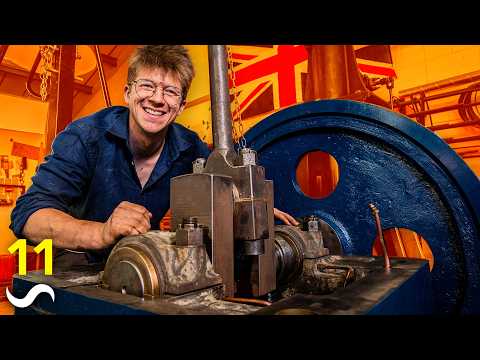
Steel dust on the magnetic filter and grit on top of the stuffing box explain why a power hammer that ran in the previous installment has to come apart again. The host puts the cleaner front cylinder alongside the dirtier rear one and shows how murky the drained oil remains after two days. It’s a brisk opening that lets the condition of the machine justify a second teardown.
The switch from a variable frequency drive to a star-delta starter makes for a clear piece of troubleshooting. The host explains what he liked about the drive, especially its gentle acceleration and adjustable speed, before describing how brief surges in current demand caused it to trip. He gives up the ability to dial in the hammer’s speed, and the startup test gives that trade-off a payoff when the Massey accepts the load that had been causing trouble.
The flywheel guard becomes an absorbing fabrication job of its own. A two-piece enclosure can fit around the motor and electrical box, but tight clearances force the host to work out an adjustable mount without bridging the isolated foundation and the workshop floor. His running commentary about the weight of the sheet steel and the amount of welding keeps the work lively. The sequence also leaves an uneasy detail in plain sight, since the first powered test takes place with the belt and flywheel still exposed.
Once the Massey is under load, the demonstration gives viewers a reason to care about the machine’s unusual controls. Clamping steel so it can be bent makes the hold-down function easy to grasp, and the host’s surprise at how slowly the ram rises after a single blow makes the trial feel candid. The explanation is harder to follow when he moves quickly among the numbered notches, hand lever, and foot treadle. A proposed glass-of-water comparison raises a good question about the foundation, but the video gives no clear account of what the comparison showed.
Forging a nine-pound sledge for his wife turns the first substantial job into something personal and gives the hammer a credible workout. The host tests a sample of the salvaged anchor-chain steel, compares the hardness readings from oil and water test quenches, and uses those results to explain his choice for the sledge. The sponsored CNC detour eventually pays off in a stamp bearing the Massey’s serial number, though the discussion of the mill’s features and sample projects delays the return to the guard.
The roughly £20,000 total, before labor, puts three months of work into perspective. Forging the sledge also brings out costs that have yet to come, as the host finds himself approaching the limits of his forge and struggling to handle the heavier stock the Massey invites him to use. His delight at the responsiveness of the treadle feels earned, and his account of what it would take for a working shop to recoup the investment gives that delight some weight.
Pros
- The grit, cloudy oil, and steel dust give the second teardown a concrete purpose.
- The startup test connects the change in motor controls to a problem viewers have already heard explained.
- The guard fabrication shows how clearance, weight, and vibration isolation complicate a seemingly modest job.
- The single-blow and hold-down demonstrations show what the Massey can do beyond repeated forging blows.
- The sledge project gives the restoration a practical payoff and shows how testing informed the treatment of salvaged steel.
- The closing cost disclosure makes the scale of the installation tangible and explicitly accounts for the exclusion of labor.
Cons
- The first powered test takes place with the flywheel and belt exposed.
- The explanation moves quickly between numbered settings and two sets of controls, making the operating sequence easy to lose.
- The glass-of-water comparison is introduced without a clear account of the result.
- The sponsored mill walkthrough stalls the guard build while it covers features and projects outside the restoration.
The Massey feels like a working shop tool by the time it shapes a gift the host has a reason to make. The episode is most satisfying when a decision made during the restoration can be judged in the next piece of work, and the sledge gives the series a fitting payoff.